
Key Takeaways
- Anxiety is one of the biggest triggers of premature ejaculation, because stress hormones put the body into a “fight or flight” state that speeds up ejaculation and creates a repeating performance anxiety loop.
- Premature ejaculation is highly treatable, and the best results often come from combining behavioral techniques, anxiety management, therapy, and doctor-guided medications like SSRIs or topical anesthetics.
- Getting help early improves both confidence and relationships, because treating the anxiety behind PE can reduce shame, rebuild sexual confidence, and improve intimacy over time.
About 1 in 3 men in the US deal with premature ejaculation at some point in their lives. That’s a lot of men. And yet, most of them suffer in silence, too embarrassed to bring it up, not knowing there’s actually a real reason it’s happening and a real way to fix it. Here’s something a lot of people don’t realize: anxiety isn’t just a feeling you get before sex.
It’s one of the biggest physical triggers of premature ejaculation. I, Dr. Alexander Heifitz, with over 30 years of clinical experience, see this connection every day. In this post, I break it down in plain, simple terms so you can finally understand what’s going on and what you can actually do about it.
So, What Exactly Is Premature Ejaculation?
Let’s start simple. Premature ejaculation (PE) is when a man ejaculates sooner than he or his partner would like, often within one minute of sexual activity. It’s not a character flaw. It’s not a weakness. It’s a medical condition, and it’s incredibly common.
Doctors usually separate it into a few different types. Some men have had it their whole life. Others developed it at some point after having normal sexual experiences. And some only notice it in certain situations, like when they’re really stressed or with a new partner.
| Type of PE | What It Means | Does Anxiety Play a Role? |
|---|---|---|
| Lifelong (Primary) PE | It’s always been there, right from the first time | Yes, often linked to early sexual anxiety |
| Acquired (Secondary) PE | Started at some point after normal function | Very common trigger, especially stress-related |
| Situational PE | Only happens in specific situations or with certain partners | Yes, directly tied to performance anxiety |
Understanding which type you’re dealing with matters because the fix can vary by type. And if anxiety is part of the picture, which it very often is, that changes how you approach treatment. If you want to learn more about what PE actually is, our premature ejaculation page walks through everything in detail.
Why Does Anxiety Cause Premature Ejaculation in the First Place?
This is the part most people don’t know. When you feel anxious, your brain sends a signal to your body that you’re in danger. It’s the classic “fight or flight” response, which basically means your body gets flooded with stress hormones like adrenaline. Your heart beats faster. Your muscles tense up. Your whole system goes on high alert.
Now, here’s the problem. That same high-alert state speeds up your body’s physical responses, including ejaculation. So when you’re anxious during sex, your nervous system is essentially pressing the fast-forward button without you asking it to. It’s not your fault. It’s just biology working against you in that moment.
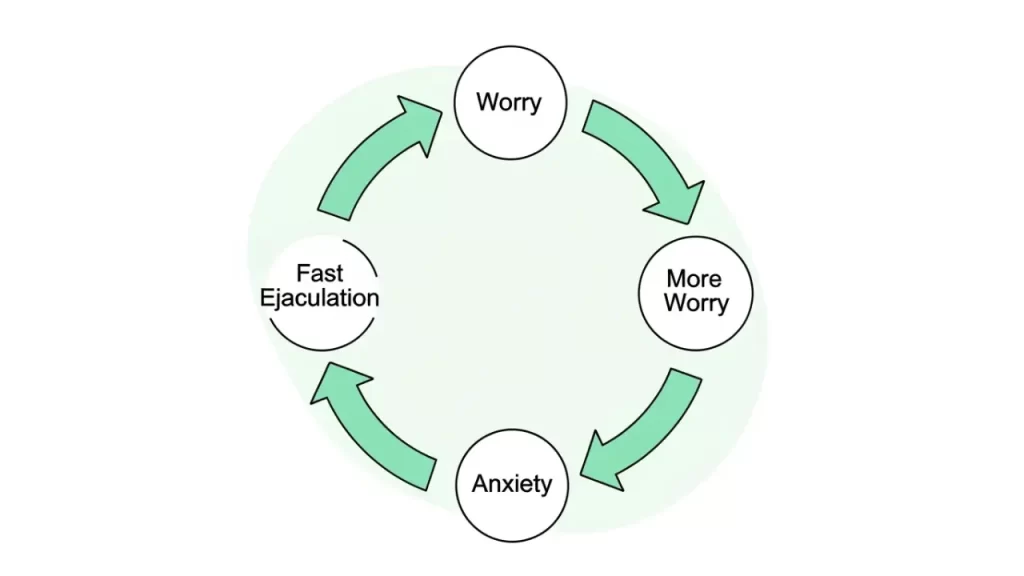
Performance anxiety specifically makes things worse because of what I call the anxiety loop. Here’s how it works:
- Step 1: You worry about finishing too fast.
- Step 2: That worry creates anxiety.
- Step 3: The anxiety makes you finish too fast.
- Step 4: That confirms your fear, so next time, you worry even more.
It becomes a loop that feeds itself. And the longer it goes on, the harder it feels to break. Honestly, it’s one of the most frustrating cycles we see at NuPharmaLife. Men come to us after months, sometimes years, of dealing with this, feeling like something is permanently wrong with them. It’s not. The loop can absolutely be broken.
Doctor-Designed Treatment
What Does Performance Anxiety Actually Feel Like?
Performance anxiety isn’t always dramatic. Sometimes it doesn’t feel like full-on panic. It can be subtle, like a quiet background worry that you barely notice until the moment it matters.
Some of the most common signs our patients describe include:
- Racing thoughts during sex, like mentally monitoring how long you’ve been going
- A tight or tense feeling in the body
- Feeling disconnected from the moment, like you’re watching yourself instead of being present
- A sudden urge to rush, even when you don’t want to
- Dreading intimacy before it even starts because of what might happen
If any of those sound familiar, you’re not alone. Millions of men feel exactly this way. And the reason it happens is that your brain is so focused on the outcome that it can’t stay in the present moment. That disconnection is actually what speeds things up.
How Does PE Affect Mental Health and Relationships Over Time?
Here’s something people don’t talk about enough. Premature ejaculation doesn’t just affect sex. It affects how a man feels about himself, his confidence, and his relationship.
Over time, the embarrassment can quietly chip away at self-esteem. Some men start avoiding intimacy altogether, making excuses to skip sexual situations because they’re scared of what will happen. That avoidance can create real distance in a relationship, even when the couple genuinely loves each other.
Partners may feel confused or rejected without knowing what’s really going on. And the man dealing with it often carries shame in silence, which makes the anxiety even worse. It’s a tough cycle. The good news is that addressing it with the right help genuinely changes lives, not just sex lives. You can also explore how we approach erectile dysfunction treatment since anxiety-related sexual concerns often overlap and respond to similar approaches.
What Are the Real Treatment Options for Anxiety-Related PE?
The most important thing to understand here is that anxiety-driven PE responds really well to treatment. You don’t have to white-knuckle your way through this forever. There are actual solutions that work, and sometimes a combination of a few approaches is the fastest path forward.

| Approach | What It Does | Best For |
|---|---|---|
| CBT (Talk Therapy) | Rewires negative thoughts about sex | Deep-rooted performance anxiety |
| Behavioral Techniques (Start-Stop / Squeeze) | Trains your body to delay ejaculation | Building physical control |
| Mindfulness and Breathing | Calms the nervous system in the moment | Anxiety reduction during sex |
| SSRIs (Medication) | Delays ejaculation by changing serotonin levels | Quick, consistent results |
| Topical Anesthetics | Reduces sensitivity to slow things down | Immediate help while managing anxiety |
| Sex Therapy | Addresses both partners, improves communication | Relationship strain due to PE |
At NuPharmaLife, I Dr. Heifitz and our licensed US physicians work with you online to figure out what combination makes sense for your situation. No awkward in-person appointments. No waiting rooms. Just a real conversation with a real doctor, from home, and a personalized plan that actually fits your life. If you want to understand stress-management techniques that pair well with PE treatment, this guide on mindfulness and stress relief is genuinely worth reading.
Can You Really Control Ejaculation With Behavioral Techniques?
Yes, and it’s more straightforward than it sounds. Two of the most well-known methods are the start-stop technique and the squeeze technique. Both work by training your body to recognize the point just before ejaculation and backing off from that edge.

The start-stop method means pausing all stimulation when you feel close, waiting until the feeling fades, then starting again. Over time, you learn to recognize your own arousal signals and stay in control of them, not the other way around.
The squeeze technique involves applying gentle pressure at the base or head of the penis when you’re close to ejaculation. This temporarily reduces arousal and resets your body. It’s a little awkward at first, but most men see real improvement within a few weeks of practice.
These aren’t magic fixes, but they work when you use them consistently. And combined with reducing anxiety through mindfulness or therapy, the results can be pretty dramatic.
Frequently Asked Questions About Premature Ejaculation and Anxiety
1. Is premature ejaculation caused by anxiety or is it a physical problem?
It’s often both. In many cases, especially when PE starts in adulthood or only happens in certain situations, anxiety is a major driver. But there can also be physical factors like hormone levels or sensitivity. That’s why a proper evaluation matters so much.
2. Can premature ejaculation go away on its own?
Sometimes, especially if it was triggered by a stressful period that has since passed. But for most men, it doesn’t just disappear without some kind of active approach. The good news is that with the right help, most people see real improvement fairly quickly.
3. Does medication really help with PE?
Yes. SSRIs (a type of antidepressant that also delays ejaculation) and topical numbing agents are both clinically proven options. They don’t work the same for everyone, which is why a licensed doctor should guide the decision.
4. Is it embarrassing to talk to a doctor about PE?
It really doesn’t have to be. Doctors like me have these conversations every single day. And with telehealth, you can do it from your phone or laptop without seeing anyone face-to-face. Most patients say they feel relieved the moment they actually reach out.
5. Does anxiety about PE make it harder to treat?
It can complicate things, but it doesn’t make treatment impossible. In fact, identifying anxiety as the trigger is actually a really good sign because it means there are very effective psychological and medical tools that directly address the root cause.
6. How long does it take to see improvement?
It depends on the approach. Some men notice improvement with medication within days. Behavioural techniques usually take a few weeks of practice. Therapy takes a bit longer but often leads to more lasting results. Most men see meaningful progress within 4 to 8 weeks of sticking to a plan.
7. Can NuPharmaLife help me with PE treatment online?
Yes. Our licensed US physicians offer discreet online consultations for premature ejaculation. You fill out a short health questionnaire, speak with a doctor, and get a personalized treatment plan, all from home. Visit our premature ejaculation treatment page to get started.
Doctor-Designed Treatment
You Don’t Have to Keep Living With This
Premature ejaculation connected to anxiety is one of the most common and most treatable men’s health concerns out there. But because it feels embarrassing to talk about, most men wait way too long to do anything about it. You don’t have to keep doing that.
The anxiety loop can be broken. The physical triggers can be managed. And your confidence in the bedroom, and beyond it, can absolutely come back. The first step is just having an honest conversation with a doctor who gets it.
At NuPharmaLife, that’s exactly what we’re here for. Talk to a licensed US doctor about PE treatment today, privately, comfortably, and from home. Reach out to us here or visit your personalized PE treatment page to take the first step.
Medical Disclaimer: This blog post is for informational and educational purposes only. It is not intended as medical advice, diagnosis, or treatment. Always consult with a qualified healthcare professional before making any changes to your diet, medications, or health routine.